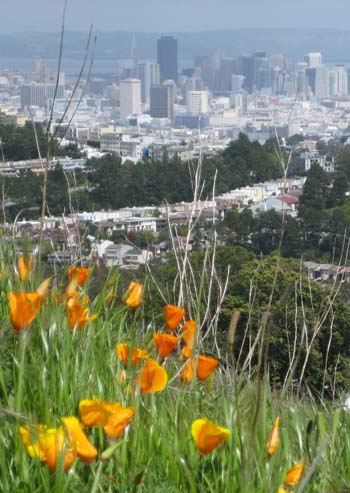
 The northeast slope of Mount Davidson supports a wonderful population of native wildflowers, grasses, and shrubs that, when planted at home, can enrich San Francisco gardens with a sense of local identity. This is also a botanical battlefield where mankind only recently has joined the fray.
Rocky soil and high winds mean only the toughest plants survive here. Stalwart coyote bush and close-growing huckleberry struggle for primacy in the shrub community, with tassel-blossomed Ribes sanguineum and golden-orange Mimulus aurantiacus bearing up between them. The massive bunchgrass Calamagrostis nutkaensis holds its ground against vigorous Festuca californica, while checker blooms, blue dicks, yellow violets and shooting stars patiently endure the siege of summer drought, emerging again after winter rains in kaleidoscopic color.
Of particular note to color-hungry gardeners, Dodecatheon hendersonii ssp. cruciatum (our local variety of shooting star) emerges in early spring, with spectacular primrose flowers of purple and yellow held aloft on foot-long reddish stems. Shooting stars remain largely unknown to mainstream retail nurseries like Sloat and the garden section of Home Depot, but specialty native plant nurseries often carry them -- try Bay Natives in San Francisco and Yerba Buena in Half Moon Bay.
Western huckleberry (Vaccinium ovatum) bears a wealth of white urn-shaped flowers throughout the summer, maturing into edible dark-blue fruit (the most deleicious of all our native berries) beautifully set off against the reddish-green luster of its evergreen leaves; it grows 2-6 feet tall and prefers well-drained, acidic soil. This is an easy, beautiful, and low-maintenance shrub that will thrive in both sun and shade, a no-brainer for the native plant garden.
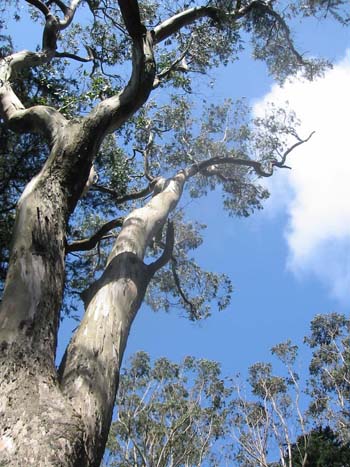 Today, only 20% of Mt. Davidson remains native -- the rest is a forest of blue gum eucalyptus, the result of massive plantings by S.F. mayor Adolph Sutro in the 1880s. An import from Australia, the blue gum quickly grows to 100 feet or more, swift to establish itself and often spreading into adjacent territory. Aficionados say the towering aromatic trees remind them of cathedrals; critics call the blue gum "California's tallest weed." Either way, the eucalyptus forest effectively crushes its competition, eliminating native plants from its domain like an occupying army.
But on the fringe between the Australian forest and the Californian grassland grows our native coast red elderberry, the hardy Sambucus racemosa. This is a large bush or a small tree, depending on conditions, with egg-shaped clusters of tiny cream-white flowers maturing into scarlet berries much prized by the local birds; these proven survivors make a proud statement in any Bay Area garden.
At the base of Mt. Davidson, where native grasslands meet the houses of Miraloma Park, a yellow snarl of entrenched Scotch Broom (Cytisus scoparius) fights its way uphill. Broom ranks among the Bay Area's most noxious and damaging weeds: this prolific invader can produce 60,000 seeds per mature plant per year, with each fallen seed remaining viable in the ground for over 50 years. Where broom is allowed to maraud unchecked, it sweeps over the land like a pack of bloodthirsty Huns, engulfing everything in its path.
Native plant enthusiast Sue Smith has led efforts to eradicate broom from Mt. Davidson's lower slopes. One day, with her group of volunteer weed-pullers, she was approached by Ted Kipping, a respected local arborist who lives in the neighborhood. He asked if she might lend her team for an assault against a division of aggressive blue gum seedlings encroaching from their established sovereignty in the eucalyptus forest and moving into native shrub and grassland territory. Sue replied that her city permit was only for pulling broom, not for cutting blue gum. Ted decided to bring his own work crew and, at his own expense, spent three days taking down every eucalyptus sapling in the disputed area. He was hailed henceforth as a local hero.
The path to Mt. Davidson's native grassland and shrub community begins at the southern end of the park, at the intersection of Dalewood, Myra, Lansdale, and Sherwood Streets. A number of paths branch off into the forest, leading around the mountain, through the eucalyptus, and up to the peak. The S.F. Recreation and Park department sprays these paths with herbicide against the weeds Ehrharta erecta and Oxalis pes-caprae, two pernicious interlopers from South Africa.
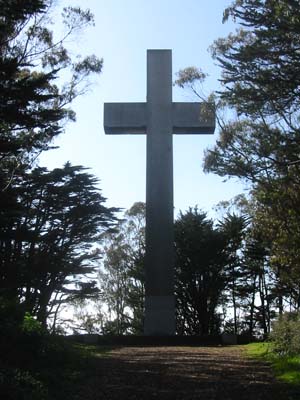 Follow the path to the top of Mt. Davidson, and you will find a concrete crucifix 100 feet tall. Inaugurated in 1934, the city-owned monument eight years ago was declared a violation of church-state separation. San Francisco voters approved a measure to sell the small parcel of cross-bearing land to a private buyer: the Council of Armenian-American Organizations of Northern California. The Armenians memorialized the site with a bronze plaque at the base of the cross, which reads: "Cared for in memory of the 1,500,000 victims of the Armenian Genocide perpetrated by the Turkish government from 1915 to 1918." Below that, in English and Armenian, is a quotation from writer and educator Avedis Aharonian:
If evil of this magnitude can be ignored,
if our own children forget
then we deserve oblivion
and earn the world's scorn.
In the 120 years since eucalyptus was first introduced to Mt. Davidson, many generations of trees have grown to full maturity; today the tall alien forest obscures the enormous cross almost completely from view. Many citizens of San Francisco have no idea it is even there.
* * *
Geoffrey Coffey practices horticultural Darwinism in San Francisco. He is the founder of Madroño landscape design studio, a principal of Bay Natives nursery, and a freelance writer for the San Francisco Chronicle.