 If local gardeners rightly consider the Bay Area a slice of Eden, then
the manzanita deserves special attention: its name is Spanish for "little
apple." Knowledge and sin may not necessarily derive from this gorgeous
evergreen, but temptation lurks always among its branches. As pioneer
horticulturist Lester Rowntree famously opined, "If I were forced to
choose only one shrubby genus, giving up all others, I would say
unhesitatingly 'Manzanitas,
please,' for they can be all things at once to the lover of shrubs,
giving you complete satisfaction at any time of year."
If local gardeners rightly consider the Bay Area a slice of Eden, then
the manzanita deserves special attention: its name is Spanish for "little
apple." Knowledge and sin may not necessarily derive from this gorgeous
evergreen, but temptation lurks always among its branches. As pioneer
horticulturist Lester Rowntree famously opined, "If I were forced to
choose only one shrubby genus, giving up all others, I would say
unhesitatingly 'Manzanitas,
please,' for they can be all things at once to the lover of shrubs,
giving you complete satisfaction at any time of year."
More accurately called Arctostaphylos (Greek for "bear grape"), this genus comprises 70 species, nearly all native to the California chaparral, with habits from low creeping ground covers to aspirant trees 20 feet tall. Such variation means there's a manzanita for every garden milieu, and to suit any gardener's taste.
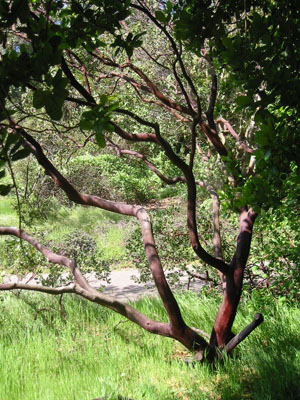
The taller forms, like Arctostaphylos manzanita (common manzanita), A. insularis (island manzanita), and A. glauca (big berry manzanita), are prized for the arresting shapes of their branches: gnarled and twisted yet surprisingly smooth to the touch, in rich variations of purplish red, they glow in the sun like burnished mahogany. Snake-like, the branches shed bark in paper-thin curls every year, allowing the trunks to expand over time. The plant becomes festooned with these ribbons of shredded bark during the summer, but eventually is washed clean by the rains of late fall; the shiny wood underneath makes a beautiful stage for the coming winter show.
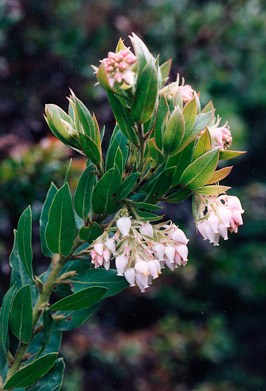 Most manzanitas begin to bloom around December, increasing
their appeal in gardens otherwise dormant during the dark months.
This welcome inflorescence occurs in dense clusters of little white
or pink flowers,
and each exquisite blossom looks like a miniature vase, the petals
completely fused so the corolla resembles a work of tiny ceramic
pottery.
Winter-hungry
hummingbirds rank among the manzanita's most ardent enthusiasts.
Most manzanitas begin to bloom around December, increasing
their appeal in gardens otherwise dormant during the dark months.
This welcome inflorescence occurs in dense clusters of little white
or pink flowers,
and each exquisite blossom looks like a miniature vase, the petals
completely fused so the corolla resembles a work of tiny ceramic
pottery.
Winter-hungry
hummingbirds rank among the manzanita's most ardent enthusiasts.
In the spring, the flowers mature into fruit, and the manzanita finds itself hung with bunches of red or orange "little apples." Birds (and more remotely, bears) feast on these edible berries. While contemporary cuisine remains unimpressed with the manzanita fruit, Native Americans and early California settlers preserved it as jelly and brewed it into cider.
Manzanita leaves can be vivid green to dark olive, sometimes with touches of blue or bronze; shapes range from oval to parallelogram, anywhere between a dime and a silver dollar in size. The leaves are usually held upright, set on edge and trembling in the breeze as if awaiting the arrival of a long-lost child.
Some mid-size manzanitas offer subtle and unusual colorations, and often make a better fit for the postage-stamp gardens of San Francisco. A. pajaroensis is a stunning 3-to-5 footer with a distinct copper hue to its foliage. The elegant silver-grey leaves of A. 'Pacific Mist' recommend this 3-foot cultivar. And the nostalgic may want to consider A. hookerii ssp. franciscana, a bushy San Francisco native with lovely light green leaves now extinct in nature; the last surviving wild plants were rescued from the Laurel Hill Cemetery just ahead of the bulldozers, and the species now continues only in botanical gardens and nurseries.
The low forms of manzanita are easiest to grow, and more suitable for rock gardens or bank coverings -- these include A. edmundsii (Little Sur manzanita), A. pumila (dune manzanita), and the named varieties of A. uva-ursi (trailing bear berry) like 'Point Reyes,' 'Wood's Red,' and 'Radiant.' They spread by creeping: the branches root freely wherever they touch ground, eventually forming a broad attractive mat. These plants prefer to grow downhill, and can be trained to hang over walls and other embankments in a striking display.
Like all chaparral plants, manzanitas require excellent drainage and prefer rocky or sandy soil. They will tolerate organic or clay soil, but only if drainage is adequate. Full sun is best, with at least a half-day of direct sunlight; low-growing forms tolerate more shade. Manzanitas are highly tolerant to drought once established; water once or twice a week during the first summer after planting, then not more than once a month thereafter. Avoid overhead watering in hot weather.
Propagation is best by cuttings; the manzanita is a notorious hybridizer both in cultivation and in nature, and therefore seed cannot be trusted to reproduce a chosen selection. Perhaps this inter-species promiscuity confirms the "little apple" as a symbol of original sin. But the manzanita also represents local pride, with 95 percent of its named species native to the Golden State.
"Manzanitas are essential for the California habitat garden," says Don Mahoney, horticultural manager at Strybing Arboretum. "They attract hummingbirds and butterflies, and offer energy-packed food for larger birds such as robins."
To grow manzanitas confirms our identity as Californians, strengthening bonds between the people, flora, and fauna of the land we call home.
* * *
Geoffrey Coffey is the founder of Madrono landscape design studio, a principal of Bay Natives nursery, and a freelance writer for the San Francisco Chronicle.