 A heavenly light shines this evening 800 feet above San Francisco Bay. Closer inspection reveals six strings of bright white bulbs hung from a 30-foot pole atop the peak of Angel Island, a tree-shaped beacon lit for the holidays. The architects of this symbolic arbor may have meant to invoke the traditional Christmas conifer or star of Bethlehem, but the display could as easily commemorate the coast live oak communities that survive here despite the infernal meddling of mankind.
In the ice age, when sea level was several hundred feet lower, San Francisco Bay was a dry, oak-studded river valley. The Sacramento and San Joaquin deltas ran through the Golden Gate and across the coastal plain to the ocean somewhere beyond the Farallons. One century or another, geologic forces thrust up this small hillock. The ice-age glaciers melted and the oceans rose, making the valley a bay and the knoll an island.
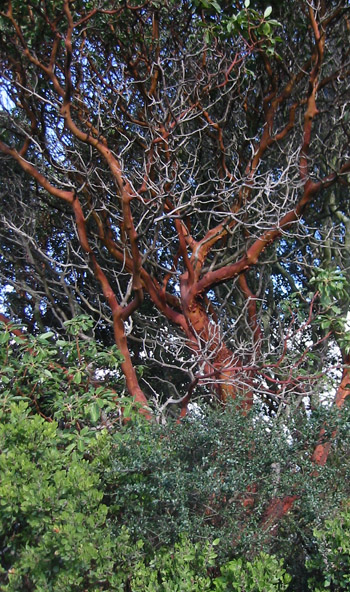
Thus separated from the mainland for the last 8,000 years, these distinctive mountain groves of Quercus agrifolia provide a window into California's past. Coast live oak covers Angel Island's north- and east-facing hills, where the sun is less strong and the water more plentiful. Thick limbs of hoary trees, gnarled biceps of the earth, rise from the slope in twisted postures, holding up a canopy that shelters innumerable birds and a vigorous population of shade-tolerant plants growing below, bright inspirations for gardeners in sun-challenged yards.
January in the oak woodlands brings hundreds of baby ferns growing from the spores of last year, greening steep wet rock faces. Among more common varieties like goldback (Pentagramma triangularis), coastal woodfern (Dryopteris arguta), and sword fern (Polystichnum munitum), Angel Island contains California maidenhair fern (Adiantum jordanii), a horticulturally valuable species. The maidenhair creeps along moist embankments and rock crevices, with fronds deeply lobed by stout fan-shaped segments like the leaves of a ginkgo tree. Small enough never to overwhelm in the garden, but big enough to draw compliments, this fern easily transforms a "problem corner" into a "primitive specimen garden."
The hillside gooseberry (Ribes californicum var. californicum), a three-foot sprawling thorn bush, gives incredible fuchsia-like flowers that mature into bird-pleasing fruit. Peeking out from the partial shade of woodland openings, it provides important habitat for nesting hummingbirds. It also makes an effective fence in the garden, attractive to its owner yet impassable by neighborhood dogs and children.
Scattered among the oaks, and gaining in number where woodland becomes chaparral, the toyon or Christmas berry (Heteromeles arbutifolia) wins the award for holiday cheer. Every December it produces stunning bunches of bright red edible berries held against lush green foliage, like yuletide garlands hanging from trees growing 10 to 20 feet tall. Biblical interpreters, take note: this genus, with its single species, is named in Greek for "different apple."
In the years between early European arrivals and California state park designation in 1963, Angel Island has hosted a few bad apples and many "exotic invasives" including cattle from Spain, eucalyptus from Australia, and soldiers from the U.S. Army. Gun batteries and garrisons took root here in 1863 after fears of a Confederate invasion during the civil war; the fortifications later proved useful as staging grounds for regiments shipping out to kill Apache, Sioux, Modoc, and other Indians of the American West. Troops passed through here en route to the Spanish-American War and to World Wars I and II, while malarial soldiers returning from the Philippines were quarantined here at the turn of the 20th century. Between 1910 and 1940, an immigration station saw hundreds of thousands of Chinese and Japanese who crossed the Pacific only to get interred here for weeks, months, or even years at a time, awaiting their slim chances to thwart the Chinese Exclusion Act by producing evidence of an American forebear.
Today's sport sailors on the bay relish the stiff southwesterlies through Raccoon Straight, the narrow channel separating Angel Island from Tiburon, but few can still spin the tale of the HMS Raccoon, a 26-gun British sloop-of-war that put aground here for repairs one week in March 1814. For their part, those old English sea-dogs likely knew nothing about Juan Manuel de Ayala, the Spanish lieutenant who anchored here to map the bay in August 1775, and for whom the island's most sheltered cove is named. Smart money would bet that Ayala learned little and cared less about the Hookooeko, the local group of Miwok whose shell mounds (at least four on Angel Island) testify to their hunting and fishing expeditions here by boat 3,000 years before the white man.
But the Hookooeko could certainly have told us about O'-ye the Coyote-Man, who planted these oaks when he created the world from a tule mat and peopled it with a handful of feathers. A walk through these oak woodlands can recall that peace of a former time. To keep the old stories alive -- and to return to the place where we started, thus to know it again for the first time -- is perhaps the greatest new year's wish of all.
* * *
Madroño founder Geoffrey Coffey is a freelance writer for the San Francisco Chronicle.